

There’s no question farm labor is hard, back-breaking work requiring hours of continuous bending, standing, squatting and heavy lifting. In North Carolina, labor-intensive crops must be harvested if the state’s $84 billion agriculture industry is to continue to flourish.
Farmers’ crops risk rotting in the fields without enough hands to harvest them. But who will show up for a job so physically exhausting?
The answer for many farmers is the H-2A temporary agricultural program, which allows farm employers who anticipate a shortage of domestic workers to bring nonimmigrant foreign workers to the U.S. to perform agricultural labor or services of a temporary or seasonal nature.
“The point of H-2A is to give farmers relief on much needed labor without depressing the wages and working conditions of U.S. workers,” says Lee Wicker, Director of N.C. Growers Association.
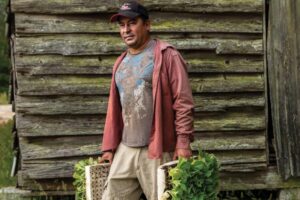
Labor of Love
Labor is not a luxury for farmers in the U.S. but rather a necessity to ensure farmers stay in business and have product to sell.
“Farmers turn to H-2A as a last resort,” says Wicker. “It’s a lot of work to get the workers to the farm, but it’s essential to harvesting labor-intensive crops.”
The H-2A program provides a reliable and vetted labor source for North Carolina farmers. Workers go through background checks at the consulate in Mexico and again with U.S. Homeland Security.
“We either import our food or our labor,” Wicker says. “Securing effective labor is essential in producing American-made food and that ensures our national security.”
Kornegay Family Farms
In Johnston County, Kornegay Family Farms began hosting H-2A workers from Mexico in 2015.
“We started with 30 guys in 2015 and doubled that to 60 guys in 2016. We have several groups of fathers, sons, brothers, in-laws, uncles, nephews and cousins here,” says Kim Kornegay LeQuire, HR and compliance manager at Kornegay Family Farms. “You would be surprised at how much you can get done despite the language barrier when there is mutual respect and an attitude of teamwork and gratitude. I feel like a mother to them.”
“Without migrant workers, we don’t have the standard of food we need in the U.S. If we depend on food offshore, it may be cheaper, but we don’t know what’s in it.”
– Jackie Thompson, Wake County farmer
She says they can reach her if anything comes up – a light out at camp, a debit card not working or a doctor visit.
“I have tried to convey to them how appreciative my family is for the sacrifices and hard work they contribute here,” she adds.
The family relies on the H-2A program for workers to harvest their crops, which include sweetpotatoes, corn, soybeans, watermelons, butternut squash, tobacco and cotton.
“It has been said that migrant workers steal jobs from Americans, but they are doing jobs Americans do not want to do,” Kornegay says. “The program requires employers to place ads in local papers and interview any local person who expresses interest. In six years, I have only had three calls from local people, and when I described the work, they told me they could not do it. We could not be successful without seasonal H-2A workers.”
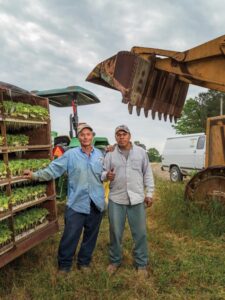
Becoming an H-2A worker is a life-changing experience for those in the program. They work in the U.S. for between five to nine months, and it allows them to provide for their family for an entire year. Kornegay sees the fruits of their labor when the workers post pictures of their children’s Christmas gifts or family trips.
“It’s very fulfilling and gives a great sense of satisfaction knowing you can make that big of a difference in someone’s life,” she says.
See more: The Value of Farm Labor
J&J Thompson Farms
Wake County farmer Jackie Thompson has been getting much-needed help from the H-2A program since 1991. He hosts 27 H-2A workers on his 900-acre farm, where his family grows tobacco, soybeans, wheat, cucumbers and canola. Thompson says without foreign labor, Americans would not have an abundant supply of safe food to eat.
“If we don’t have H-2A, we don’t have a farm,” he says. “These guys are accountable. They are not a drag on our national debt.”
Like many other farmers, Thompson has struggled to find local workers willing to harvest his crops.
“Unfortunately, we don’t have people in the U.S. who want these jobs,” he says. “Our society does not realize food production takes backbreaking work. They are not willing to do it.”
See more: What’s It Like to Raise a Family on the Farm?
He has been hosting many of the same workers for 20-plus years and has watched them grow in various stages of life. He says they’re like family. Thompson’s need for migrant workers began in the late 1980s, but prior to the H-2A program, farmers couldn’t depend on them.
“They could be working for us one day, and then accept a better offer the next and be gone,” Thompson says. “When the H-2A program came along, it was a bona fide program with dependable workers, rules and regulations that help with our concerns.”
Though many don’t realize it, it has also been great for all Americans.
“Without migrant workers, we don’t have the standard of food we need in the U.S.,” Thompson says. “If we depend on food offshore, it may be cheaper, but we don’t know what’s in it. Our government sanctions mandate that our food is safe, but we have to have workers to harvest it.”

Patterson Farm’s Helpful Labor
Patterson Farm Inc. in Rowan County gets help from nearly 200 H-2A workers from Mexico each year. Many of these same men have been working seasonally since the farm started using the program in 1992. Doug Patterson, who runs the farm with his brother Randall, says if it weren’t for the workers, the farm that has supported their family for four generations would not survive.
“In July during our peak season, we have about 300 total employees, and 180 are H-2A workers,” Patterson says. “We started using the program 30 years ago because we had to. We need seasonal workers from March until the end of October, and you cannot find that labor here in the U.S.”
The family welcomes their crew every spring to help with strawberries, and the workers live on the farm in housing provided by the Patterson family until they go back to Mexico in late October after all crops are harvested. Patterson estimates about 80% of the men are repeat workers whom they know well and consider to be part of their family.
See more: Ask a Farmer: Why Farming?

“With our longtime workers, we know all about their kids, and they know my kids. We all dread saying goodbye because we miss them,” he says.
Patterson says the workers appreciate the program because it allows them to live and work legally in the U.S. for part of the year, and then they can go home and spend the holidays with their families.
“People sometimes think we are taking advantage of these workers,” he notes. “But in reality, the guys are making around $13 per hour here. In Mexico, they were making $8 per day. They all love this program, and they hope it continues because they depend on it.”
– Jessica Mozo



Comments
Comments are closed.

Busco trabajo
Tengo pasaporte vencido puedo moverme hacer trámites…
Supe de su empresa por un conocido
Gracias espero respuesta 👌