

From fruit flies to mosquitoes, most of us have dealt with our fair share of pesky insects. But while annoying, many common insects are virtually harmless. That’s not the case with some of the invasive insect species that have been found in North Carolina or close by.

The Culprits – Invasive Species
“There are several invasive species we’re facing here in North Carolina, but some of the worst include the hemlock woolly adelgid and the emerald ash borer,” says Dr. Kelly Oten, assistant professor and Extension specialist of forest health in the Department of Forestry and Environmental Resources at North Carolina State University. “We’ve been dealing with the hemlock woolly adelgid in North Carolina for about 30 years, and it kills hemlock trees. Emerald ash borers kill ash trees. It’s not good when one insect can kill the vast majority of a single genus of tree.”
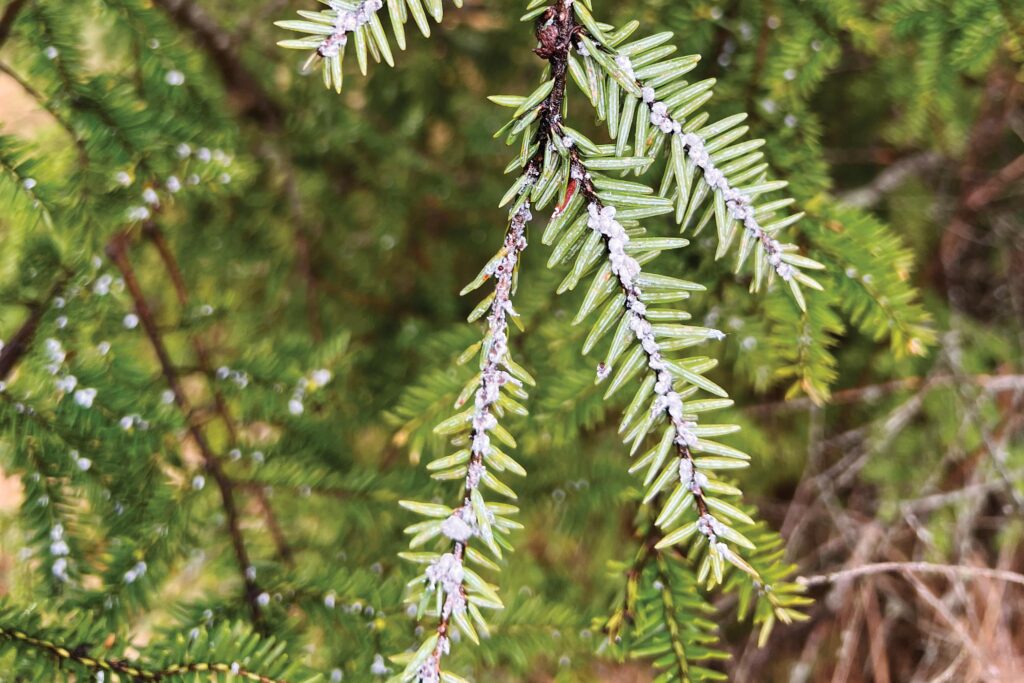
Oten has been with NC State for more than four years conducting research on invasive species. She says she loved insects from a young age and knew she wanted to be an entomologist. Her current work is a natural progression.
“This was something I loved learning about, and it fit with me wanting to make a difference and greater impact in my community and our forests,” she says.
Battling Bad Bugs
Oten’s research focuses on how to help manage the invasive pests in the state long term. Pesticides are one option to control the invasive species, but that’s not always feasible in large-scale forests. It’s also a short-term solution to a long-term problem. Instead, Oten is focusing on things like biological control agents and increased resistance of trees.

“A biological control agent is a natural predator or parasitoid that will attack the invasive insects and kill them,” Oten says. “The whole goal of the program is to establish a natural predator/prey relationship.”
As for enhancing resistance, Oten says there are some trees that survive the attack with defenses that researchers are still studying.

“We’re looking at surviving ash, but other programs are investigating hybridizing trees and trying to see if there’s a genetic component to survival,” she says.
Annoyance for Agriculture
Hemlock woolly adelgid and emerald ash borers are certainly threatening, but they primarily attack North Carolina’s forests and ecosystems. The impact is ecological, though there’s also a small component that impacts the nursery industry and growers who sell those tree species. But a different pest, the spotted lanternfly, is more threatening to North Carolina’s agricultural industry, as it feeds on grapevines, removing their nutrients.

“Obviously without nutrients, those vines can’t produce many grapes,” Oten says. “If there’s an infestation of spotted lanternfly, a grower can see up to a 90% reduction in their grape crop. What’s more, the insect produces a sweet, sticky, messy substance called honeydew. Then sooty mold grows on honeydew, which can contaminate crops. Worst of all, while spotted lanternfly hasn’t yet invaded North Carolina vineyards, many grapevines are being killed in states where it has.”
Beating the Bugs
Oten says that along with her research, it’s important for North Carolinians to do their part to help eradicate the bugs.
“If you see something that doesn’t belong here, report it,” she says. “There have been so many cases where people have seen one of these insects and they didn’t know where or how to report it. We’d much rather have a false ID than a missed detection.”

If an infestation is found in the first or second year the bug is around, it’s much easier to control, Oten adds.
There’s also a national campaign urging consumers to burn firewood within 50 miles of where it was cut if it’s untreated to help stop the spread.
“Invasive species can hide in firewood, so if someone’s ash tree is dying, they cut it into firewood then bring it camping, that could spread the insect,” Oten says.
Consumers can visit poolsidepests.com to report sightings of the spotted lanternfly and Asian longhorned beetle, which are attracted to water. They can also contact the NC State Extension, North Carolina Department of Agriculture and Consumer Services or North Carolina Forest Service.
“We do lots of public events where we’ll hand out keychains and koozies with pictures of the insects on them,” Oten says. “We’re always trying to spread awareness and be proactive about protecting our state’s ecosystems and crops.”



Comments
Comments are closed.
I’ve seen all 3 of these bugs in my yard currently (last 3 years). Longer for Hemlocks. Woodfin NC. Is there assistance in getting rid of? Thanks
I have found a green in color bugs on my plants. Not sure what they are. Their eating my herb plants and peach and plum tree leaves.