

What’s better than a basket of North Carolina peaches at a fruit stand on your way to the beach or when driving past local orchards? Whether in a cobbler, ice cream or freshly picked, a juicy peach on a hot day is hard to beat. These fresh, fuzzy fruits delight people of all ages.

Just Peachy
“There’s something special about a North Carolina peach,” says Brad Thompson, peach farmer, president of the North Carolina Peach Growers Society and agronomist with the state Department of Agriculture and Consumer Services. “It has a better flavor and tastes better than a peach grown elsewhere.”
North Carolina peaches can be grown throughout the state from the mountains to the coast but are mainly produced in the Sandhills region of Montgomery, Moore, Richmond and Anson counties.

Bynum Farm
Bynum Farm in Windblow, a small Sandhills community in Ellerbe, is where third-generation farmer and Richmond County Farm Bureau member Danny Bynum grows peaches along with other fruits and vegetables.
“Peaches love the Sandhills and do well in the sandy soil,” Bynum says. “It’s been proven that peaches have a higher sugar content when grown in the Sandhills. A peach won’t be as good in clay or black dirt.”
In 1922, Charlie Howard and Onis Carpenter Bynum relocated on a horse and wagon from the rocky, clay hills of Lincoln County to Windblow. Once established, they planted tobacco, cotton, peanuts, corn, watermelon, cantaloupe and, eventually, peaches. The Bynum family has been growing crops on that same land ever since.
Their grandson, Danny Bynum, took over the farm in 1989 from his dad and uncle and continued growing peaches.
“When you’re at the stand in the summertime and someone says, ‘It’s so good,’ it makes me happy because I know I had something to do with it,” Bynum says.

Kalawi Farm
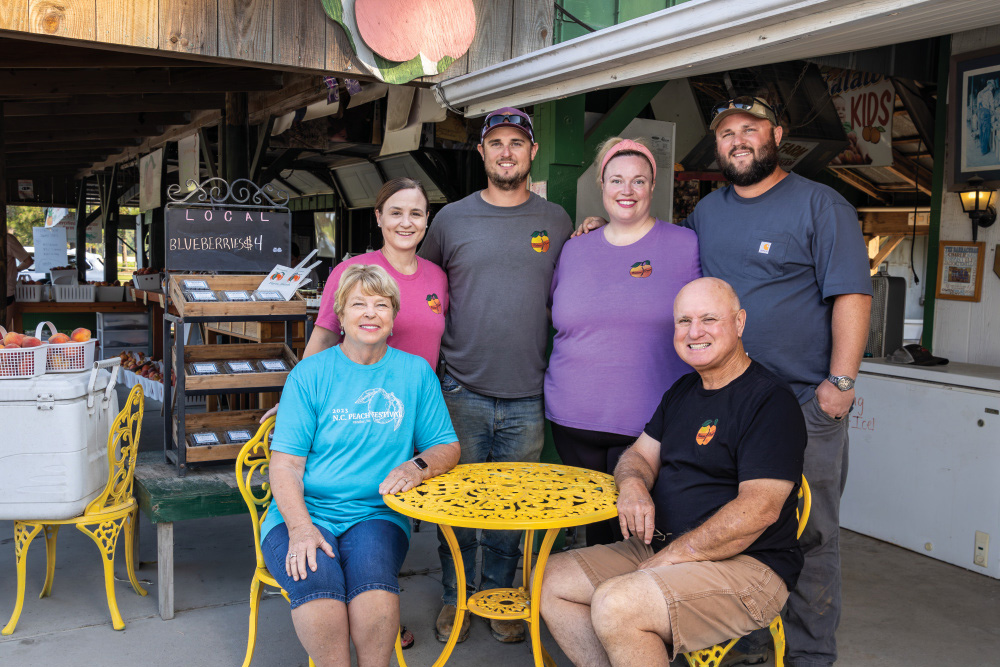
In Eagle Springs, just down the road from Candor in Moore County, Kalawi Farm is a fourth-generation peach farm run by the Williams family. Moore County Farm Bureau member Jan Williams grew up on a peach farm and dove into farming after teaching for 10 years.
“I didn’t realize how much peach farming was in my blood,” Williams says. “Picking peaches in the summer, raising peaches and children became a way of life for me.”

The farm is truly a family affair with even the farm name paying tribute to Williams’ first three children – “Ka” for Katie, “La” for Laura and “Wi” for Will. Once her kids got older and were able to work with her on the farm, they expanded the family business to include Ben’s Ice Cream (named after their fourth child), a fall corn maze and Christmas at Kalawi. Williams also honors her 10 grandchildren on the farm as the flavors offered at the ice cream shop are named after them, including Paisley’s Popular Peach, Nash’s Nanner Pudding, Maggie’s Moose Tracks and more.
The Pitfalls of Peach Growing
“Raising peaches is like going to Las Vegas – you’ll probably lose more than you’ll win,” Bynum says.
Bynum is quick to point out that weather is the No. 1 challenge when growing peaches.

Recipes
Fresh Peach Ice Cream Recipe
“You can control the rest with sprays, but there’s nothing you can do about the weather,” he says. “I don’t worry about it and I don’t do anything to prepare for the weather. If the Lord wants me to have peaches, I’ll have some.”
Candor claims to be the peach capital of North Carolina, where at one time there were more than 43,000 acres of peach trees planted in the Sandhills. Peaches have become increasingly harder to grow in North Carolina due to inconsistent spring weather with peach acreage declining significantly over the past 20 years.

Out of 114,000 acres of peaches grown in the U.S. in 2022, only around 1,200 of those acres are in North Carolina, according to the 2022 Census of Agriculture.
“The climate is a big part of why North Carolina is growing less peaches,” Thompson says. “It’s harder and harder to get a consistent crop.”
Not knowing if there will be a good peach crop is a major concern felt by all peach farmers.
“Every spring we worry the blooms will be early and then it’ll freeze,” Williams says. “It has happened a lot the last few years, and it can be very discouraging.”

The Fruits of Their Labor
For North Carolina peaches to grow well in the spring and break dormancy from the winter weather, they must be exposed to temperatures in the 40-degree range for a required number of hours during the dormant season, known as the tree’s chilling requirement. Most North Carolina peach varieties have a chilling requirement of approximately 750 hours.
Fruit breeders are now developing “high chill” peach varieties, which need closer to 1,000 chilling hours. Extending the number of chilling hours prevents flowers from blossoming too early and decreases the risk of frost damage, leading to a more successful peach crop.
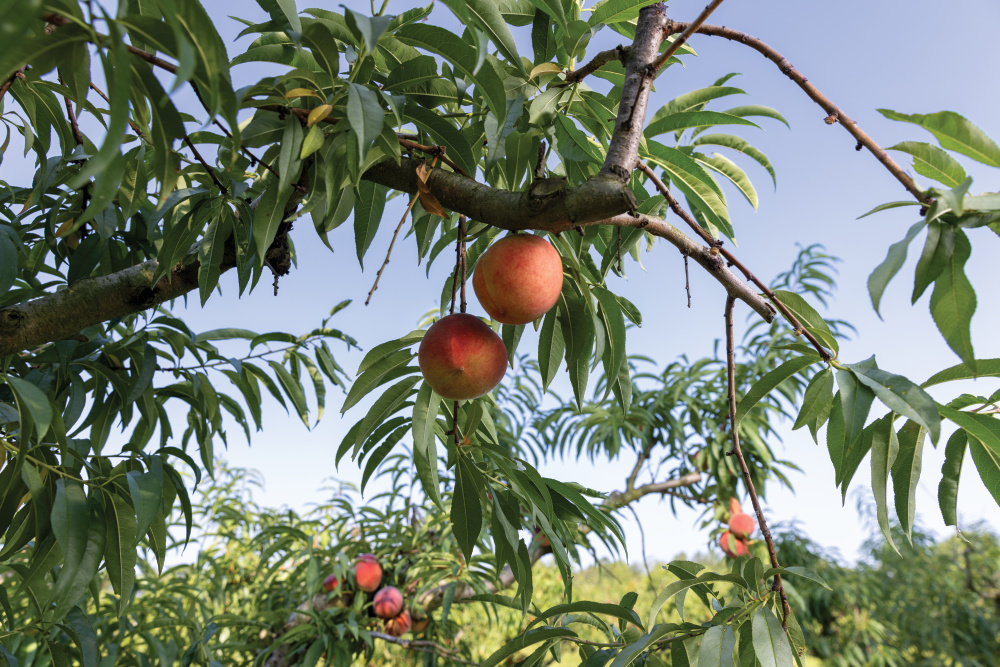
A symbol of longevity, peaches will always have a special place in North Carolina agriculture. Raising peaches isn’t only a family business for North Carolina farmers, but a labor of love.
“I love the fruit,” Williams says. “And I love watching it grow on the trees and then seeing the beautiful blooms in the spring.”
If You Go…
Looking for local peaches? Find Bynum Peach Farm at 119 Gallimore Road in Ellerbe. To check availability, call (910) 652-2204 or visit bynumpeachfarms.com. Kalawi Farm is located at 1515 NC Highway 211 in Eagle Springs. You can reach them at (910) 673-5996 or kalawifarm.net.

Comments
Comments are closed.

I’m a new resident to NC and my realtor recommended the farm bureau for insurance. My insurance rep is the best. Little did I know that I’d get the best magazine too! Thank you for great articles on North Carolina and its farming communities. I pray that farming continues to be viable.