
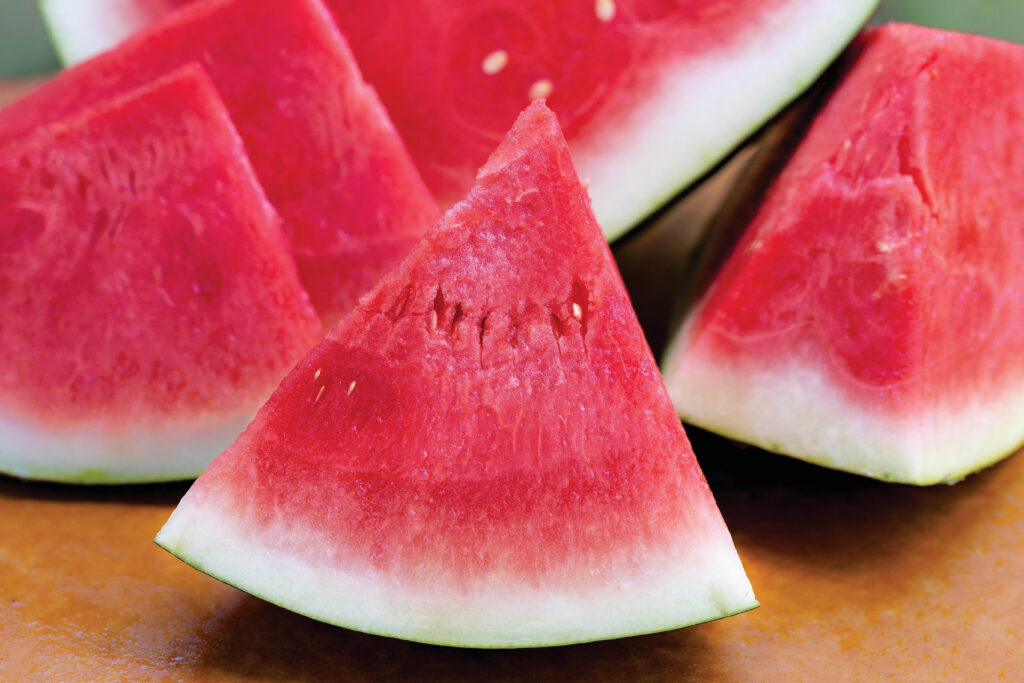
Nothing says summer like biting into a cool North Carolina watermelon slice on a hot summer day. Not only is this seasonal treat delicious and refreshing, but it’s also good for you. High in potassium, antioxidants, amino acids, lycopene, and vitamins A and C, watermelon also hydrates your body since, as the name says, it contains about 92% water.
Lucky for us, locally grown watermelons are abundant all season long. According to the U.S. Department of Agriculture, North Carolina ranks fifth in the country in watermelon production, which is 8% of the nation’s 3 billion pounds of watermelon grown annually.
Sweet & Seedless
With more than 1,200 watermelon varieties in 96 countries worldwide, the vast majority of North Carolina watermelons are seedless varieties. The National Watermelon Promotion Board credits H. Kihara, a Japanese scientist and professor at Kyoto University, with developing seedless watermelons back in 1951 and Indiana professor O.J. Eigsti with bringing that research to the U.S. Their collaboration resulted in the ability to produce watermelons that look and taste like seeded melons – without the black seeds. They look and taste the same but have small, white, edible “seeds” instead – which are empty seed coats where a seed didn’t mature.

So how do you grow a seedless watermelon if it doesn’t have seeds? Well, seeds are still involved.
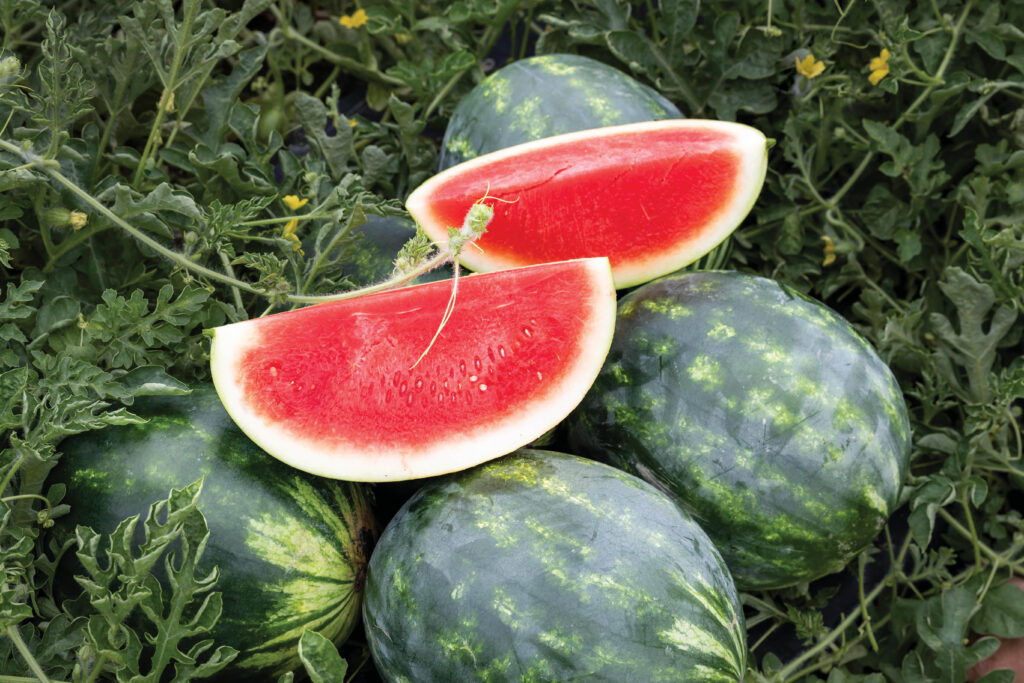
Even though North Carolina farmers mainly produce seedless varieties, most plant a few acres of seeded watermelons, as you must cross a seedless bloom with a seeded pollen to produce a seedless variety. They grow seeds in trays in temperature-controlled greenhouses before transplanting into the ground, though some plant watermelon seeds directly into their fields.
Planting takes place in April, after the last frost, and the fruit grows for around 100 days before being harvested in late summer or fall.
LizCo Farms
Watermelon producer Cody Waters of LizCo Farms in Rocky Mount has spent his whole life around farms.

“When I got old enough, I worked for my granddaddy on the farm,” he says.
After graduating from Virginia Commonwealth University, Waters joined an agriculture lending business. He now writes crop insurance for North Carolina farmers in addition to growing watermelons on the farm that he and his wife, Elizabeth, started in 2015.
“We first grew pumpkins but found they aren’t suitable for our growing climate, as you need colder temperatures,” Waters says.

In their first year, they farmed half an acre of watermelons and have steadily increased their acreage.
“You’ve got to grow in size to fit your operation, and I now have the labor and infrastructure in place,” he says.
Waters is active in the NC Watermelon Association and was the 2024 chair of NC Farm Bureau’s Young Farmers & Ranchers, saying it’s one of the best things he’s ever been a part of.
“We’ve talked with senators in Washington, D.C., about national-level agriculture decisions and seen how ag policy is written,” Waters says. “If things are affecting us in North Carolina, chances are they’re affecting folks in other states too. It’s important that we have one united voice.”
Murfreesboro Farms
Third-generation watermelon farmer and Hertford County Farm Bureau board member Mike Bunch didn’t see himself doing anything other than growing watermelons.
“Ever since I was a little boy, old enough to walk, I was in the watermelon field,” says Bunch, owner of Murfreesboro Farms.
After attending NC State University with a concentration in agricultural business, Bunch moved back to Murfreesboro to farm with his dad.
“My grandfather was a sharecropper who grew melons on a small scale, pulling a mule and cart,” he adds.

Bunch’s father added more acres to the farm, then retired in 1999 as his son took over the operation.
Murfreesboro Farms continues to be a family operation, growing peanuts, soybeans and melons.
Bunch’s wife, Vanessa, and their two sons, Michael and Nicholas, all work on the farm.
They have a few seeded watermelon acres that serve as pollinators, with 90% of their acres growing two seedless varieties, Exclamation and 7187.
“We always try about 20 acres of something different,” Bunch says. “It’s too expensive to put more acres in when you don’t know what they’re going to do.”
Howell Farming Company
Garrett Howell of Howell Farming Company in Goldsboro started his watermelon career early too. His grandfather owned land passed down to his father, who shifted from growing hay, beans, sweetpotatoes and tobacco to watermelon.
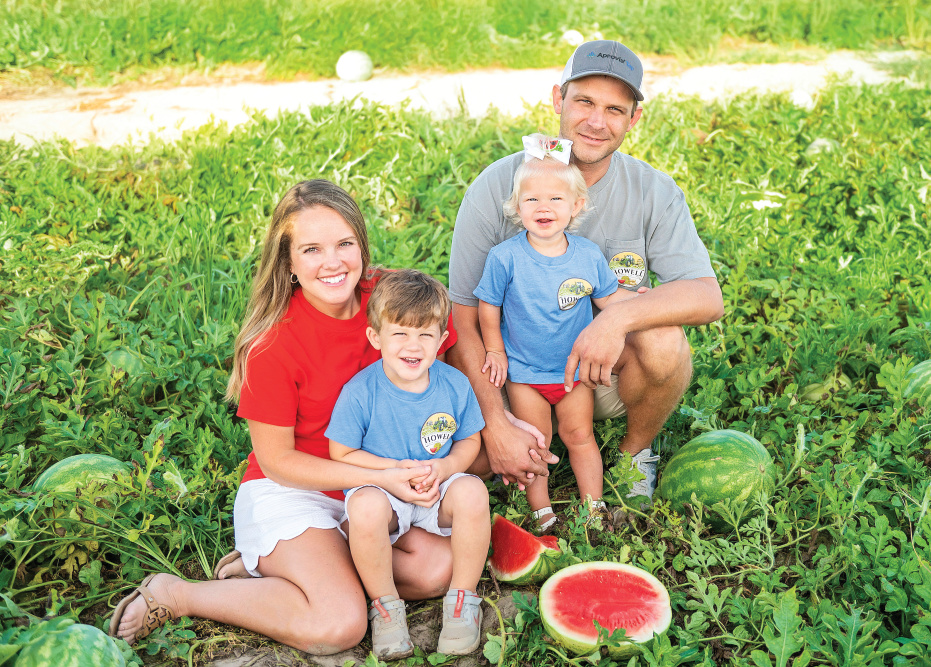
“I was 12 years old when we started growing watermelons, all seedless,” Howell says.
They now grow watermelon, sweetpotatoes, soybeans and broccoli in the cooler months. All Howell family members are involved in the farm business, with Garrett handling field operations.
“My sister, Melissa, works in the office; her husband, Danny, manages the packaging house; my dad helps in the fields, and my mom is the brains of the operation managing the books – she tells us what we can and can’t do,” Howell says.

Howell grows all seedless watermelons, including Jet Ski and 7187, both sweet and great tasting.
“Last year, our main variety was 7187, a seedless full-size workhorse variety,” Howell says. “It may not break any yield records, but it’s consistent, tough, good in our environment and has good packability.”

Love for North Carolina Watermelons
All three growers agree that they love tending the watermelons.
“It’s a beautiful crop,” Bunch says. “I enjoy seeing the plant change daily, the blooms and the sitting melons.”
Seeing weekly and sometimes daily progress is an exciting aspect of producing fast-growing watermelons.
“There’s nothing that tastes better than eating a watermelon grown in the field when it’s 90 degrees,” Waters says.



Comments
Comments are closed.

If these are seedless watermelons then why do I see seeds in the ones in your pictures you posting ?