At NC State’s College of Agriculture and Life Sciences, researchers are developing next-generation solutions to address labor shortages and improve animal welfare, safety and productivity in the poultry industry.
Article sponsored by NC State University Office of Research and Innovation.
North Carolina poultry farmers produce roughly 10% of the nation’s supply. And in our state alone, the poultry industry generates about $40 billion in annual economic impact.
The poultry industry’s shift toward cage-free systems, while certainly better for the birds, has led to more hens laying eggs on the floor, which someone – or something – has to pick up.
“Floor eggs can account for 2 to 15% of total production in certain environments, and collecting these eggs requires time and labor, and delays can affect product quality,” Ramesh Bist, a researcher at NC State University, recently told CALS Magazine. “If you’ve got around 100,000 birds, that could mean anywhere from 2,000 to 15,000 eggs ending up on the floor each day. It takes a lot of time and labor to collect them all.”
From autonomous egg-collecting robots to intelligent systems that can assess the health of individual birds, Bist’s Artificial Intelligence and Robotics (AIR) Lab is developing next-generation solutions to address labor shortages – and improve animal welfare, safety and productivity in the poultry industry.
“Agriculture will always be deeply human-centered,” says Bist, an assistant professor in the Department of Biological and Agricultural Engineering. “But the farms of the future will see humanoid robots working alongside farmers, bringing human-like intelligence and support to everyday farm tasks.”
Since Bist joined NC State in summer 2025, he’s spent many hours pursuing future-focused solutions in the College of Agriculture and Life Sciences’ (CALS) Chicken Education Unit.
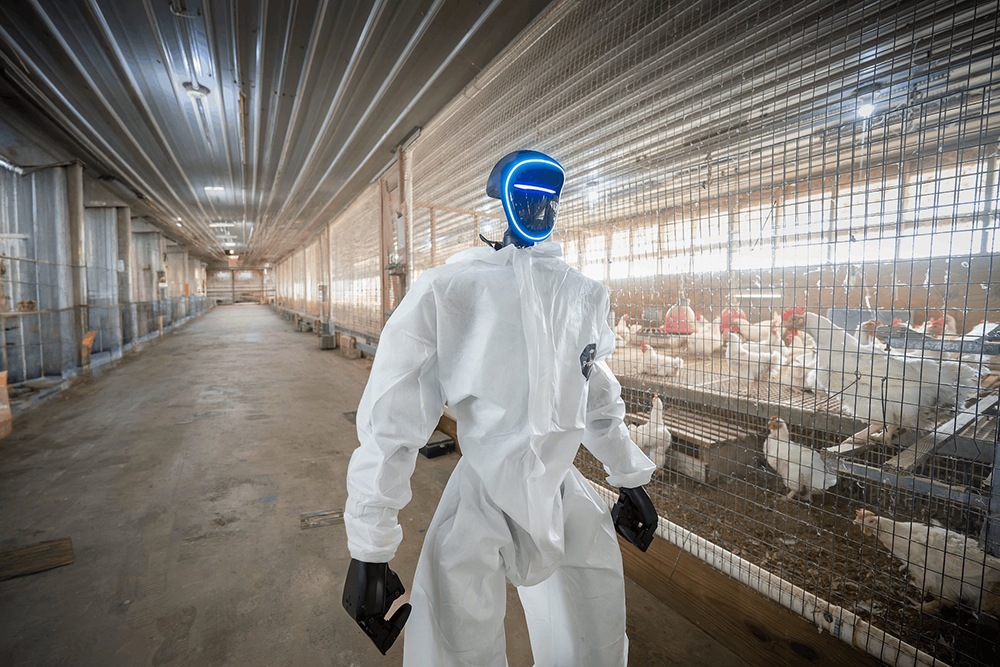
Perhaps the most futuristic solution that his AIR lab is currently pursuing is a 4-foot-tall humanoid robot with a blue luminescent face – dubbed “Howl” by the team that programmed it – to detect and collect floor eggs.
“The poultry industry is facing a labor shortage, and consequently, robotics and AI can help with daily tasks,” says Edgar Oviedo, a professor in the Prestage Department of Poultry Science who works with Bist on several AI-related research projects. “Poultry production requires a lot of labor, and even with automation, there are many issues with automatic scales and methods for collecting eggs, handling birds or processing them.”
See more: 9 Fun Facts About Eggs
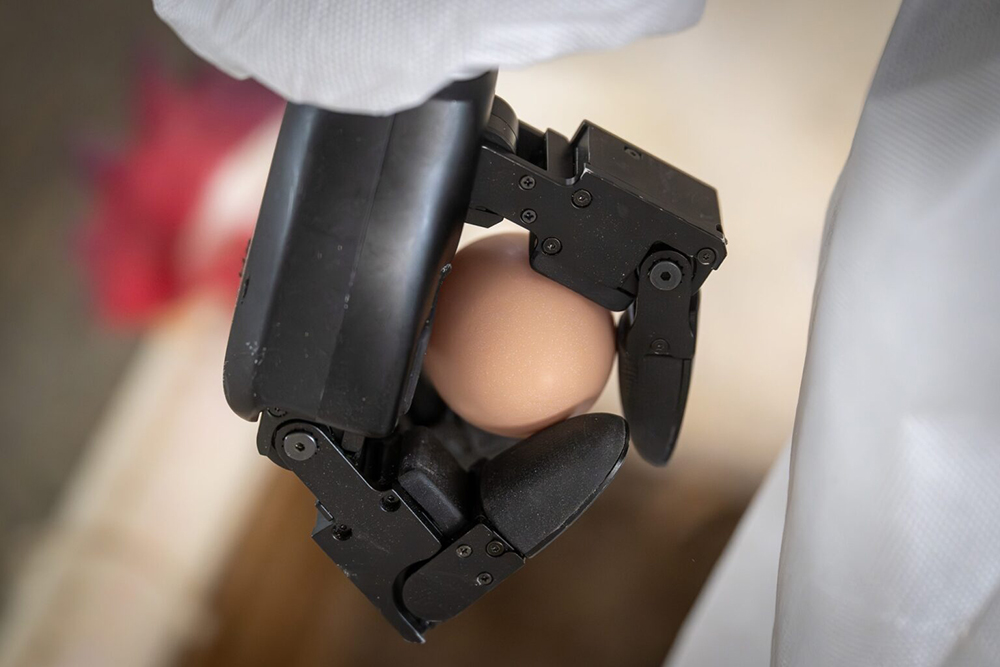
Since the researchers are working in largely uncharted territory, they have to start from scratch to code Howl’s every movement and response. With a few more months of work, the team hopes to have Howl ready for egg-detection and retrieval simulations.
As the AIR Lab’s research efforts come closer to fruition, Bist’s goal remains focused on bringing breakthroughs in precision agriculture to the hardworking farmers and growers of North Carolina – and the nation.
“The next era of farming will be built by people, strengthened by intelligent machines and driven by a vision to feed the future,” Bist says.
Learn more at go.ncsu.edu/research-works-farm.