
As soon as he saw the experiment organized within a testing plot in Illinois, Farm Bureau member and former R. Flake Shaw Scholarship winner Austin Winslow wanted to do the same thing here in North Carolina.
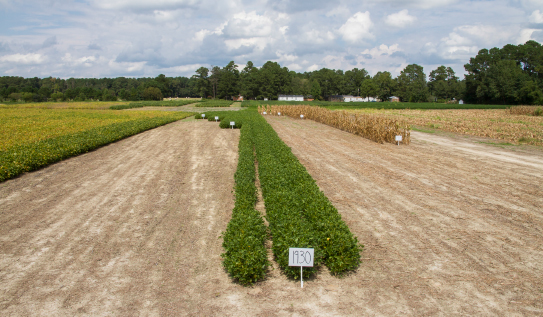
Winslow, an agronomic research manager with Monsanto, created a real-life bar chart showing how much yields have improved in the production of corn and soybeans. Using space within the company’s research land near Micro in Johnston County, Winslow was able to demonstrate how much less land it takes to grow one bushel of the crop nowadays as compared to U.S. Department of Agriculture averages going all the way back to 1930.
“My intention was to show folks where we’ve been and where we’re going,” Winslow says. “I’d said it’s been one of my favorite projects. With a plot like this one, it just speaks volumes because you can just look at it and see how much different it is. It’s a very visual thing to demonstrate. It’s like a bar graph in the field.”
Winslow’s work with Monsanto took him to Monmouth, Illinois, a city less than 40 miles from the Iowa border. He participated in a research event there when crop testers assembled a similar project that was viewed by not only company employees but also other farmers, college students and schoolchildren. He was looking to provide a similar training example here, highlighting how much production agriculture has improved in North Carolina.
“You could argue that there are a lot of reasons why we’ve become more efficient,” says Winslow, who received the Shaw scholarship in 2002 and graduated from N.C. State University four years later.
“There are different tilling practices that have been a big help, conversation tillage and no tillage. And also the breeding of the crops has come a long way. The pedigrees we’re working with are getting better and better and more adaptable for our environment. There is definitely a trend, and we’re getting better and better,” he adds.